What are landing page best practices?
Landing page best practices are the design, copy, and technical standards that consistently produce higher conversion rates across industries and traffic sources. They aren't style preferences — each one exists because it has won repeatedly in A/B tests over real traffic. The list below is distilled from 500+ landing pages we've designed and tested for ecommerce and DTC brands, and it's the same checklist our own landing page design service builds against. (New to the format itself? Start with what a landing page is and come back.)
A note before the list: best practices are the floor, not the ceiling. They prevent the unforced errors that quietly cost most pages 20–40% of their potential conversion. The ceiling comes from research specific to your audience — which no generic list can supply.
What should a high-converting landing page include?
Every high-converting landing page contains the same skeleton, whatever its visual style: a headline that continues the ad's promise, a subheadline that makes the offer concrete, one primary CTA repeated at decision moments, proof (reviews, results, logos) adjacent to the claims it supports, a section that handles the top two or three objections, and an offer framed with clear risk reversal. Strip any winning page to its bones and you'll find this structure.
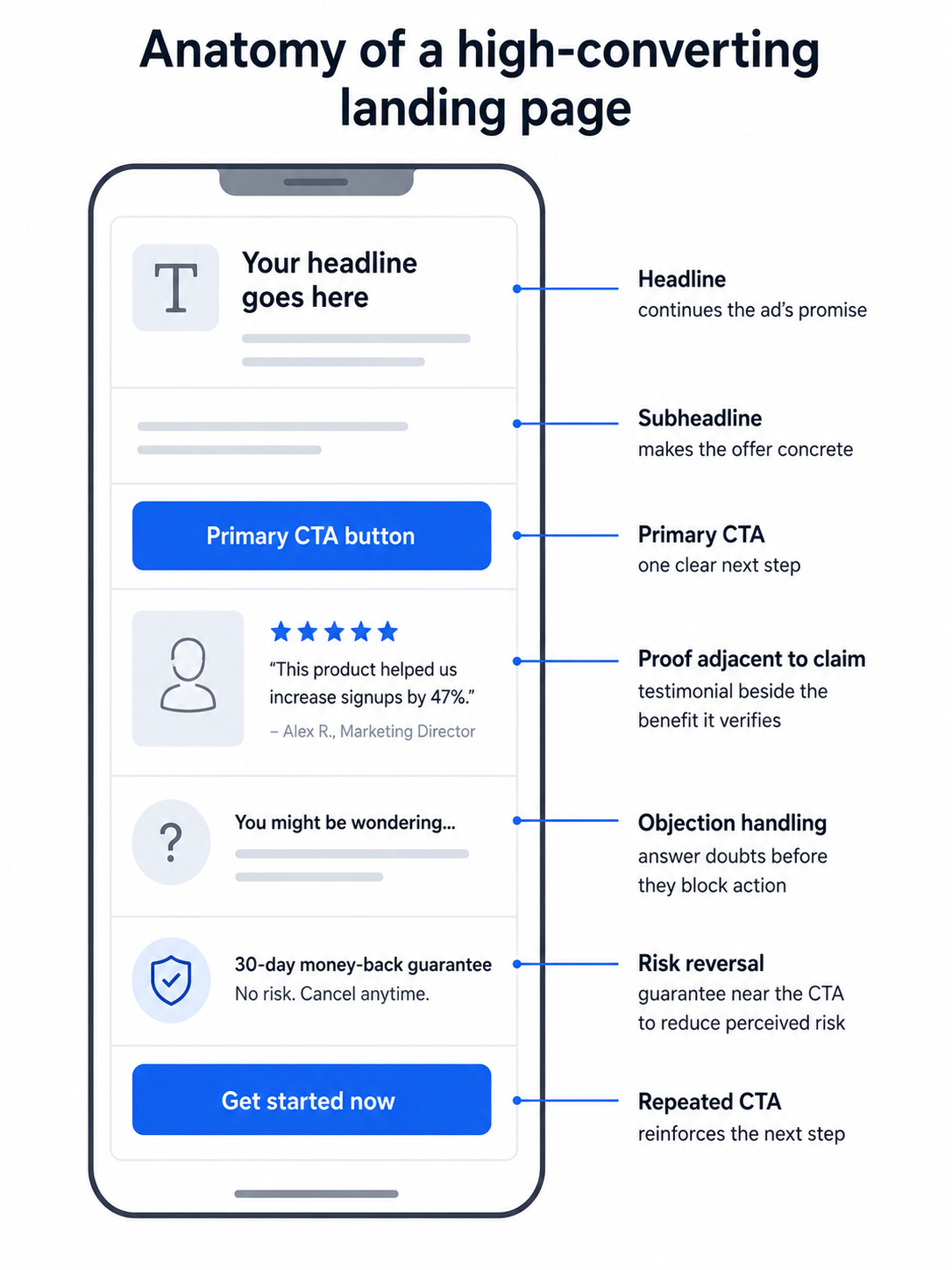
The 12 landing page best practices that move conversion rate
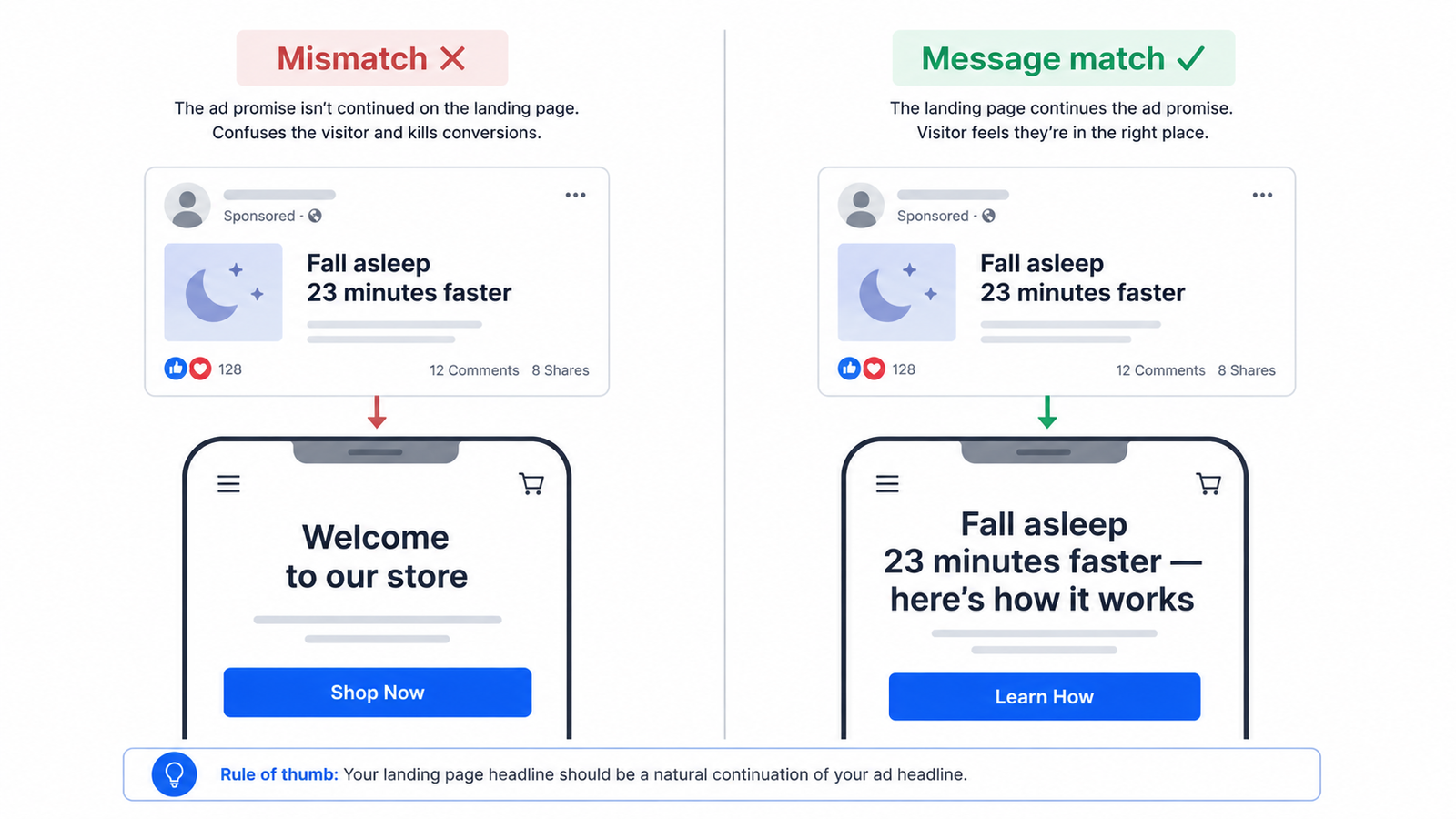
- Match your message to the ad. The headline should continue the exact conversation the ad started — same promise, same language, ideally the same imagery. Message mismatch is the single most common leak we find in audits: the visitor clicks for one thing, lands on another, and bounces in under four seconds.
- One page, one goal, one CTA. Every additional action a page offers cannibalises the primary one. Remove the navigation bar, the footer link farm, and the social icons. The only choice on the page should be the conversion or the back button.
- Put the CTA above the fold — and repeat it. A meaningful fraction of ready buyers convert immediately if you let them. Place the first CTA in the opening viewport, then repeat it after each major proof section, where conviction peaks.
- Design mobile-first. 70%+ of paid social traffic is on a phone. Design the 375px experience first: thumb-zone CTA placement, compressed sections, tappable proof. The desktop version is an adaptation, never the master.
- Load in under 2.5 seconds. Speed is a conversion variable. Every second of mobile load time costs measurable conversion, and Core Web Vitals (LCP under 2.5s) also affect your ad quality scores. WebP images, lazy loading, minimal scripts.
- Lead with benefits, prove with specifics. The headline sells the outcome; the body earns belief with mechanisms, numbers, and ingredients. "Fall asleep 23 minutes faster" outperforms "premium sleep support" in every category we've tested.
- Use your customers' words. Mine reviews and support tickets for the exact phrases buyers use, and write the page in that language. "Bloated after lunch" beats "digestive wellness" because the visitor recognises themselves in it.
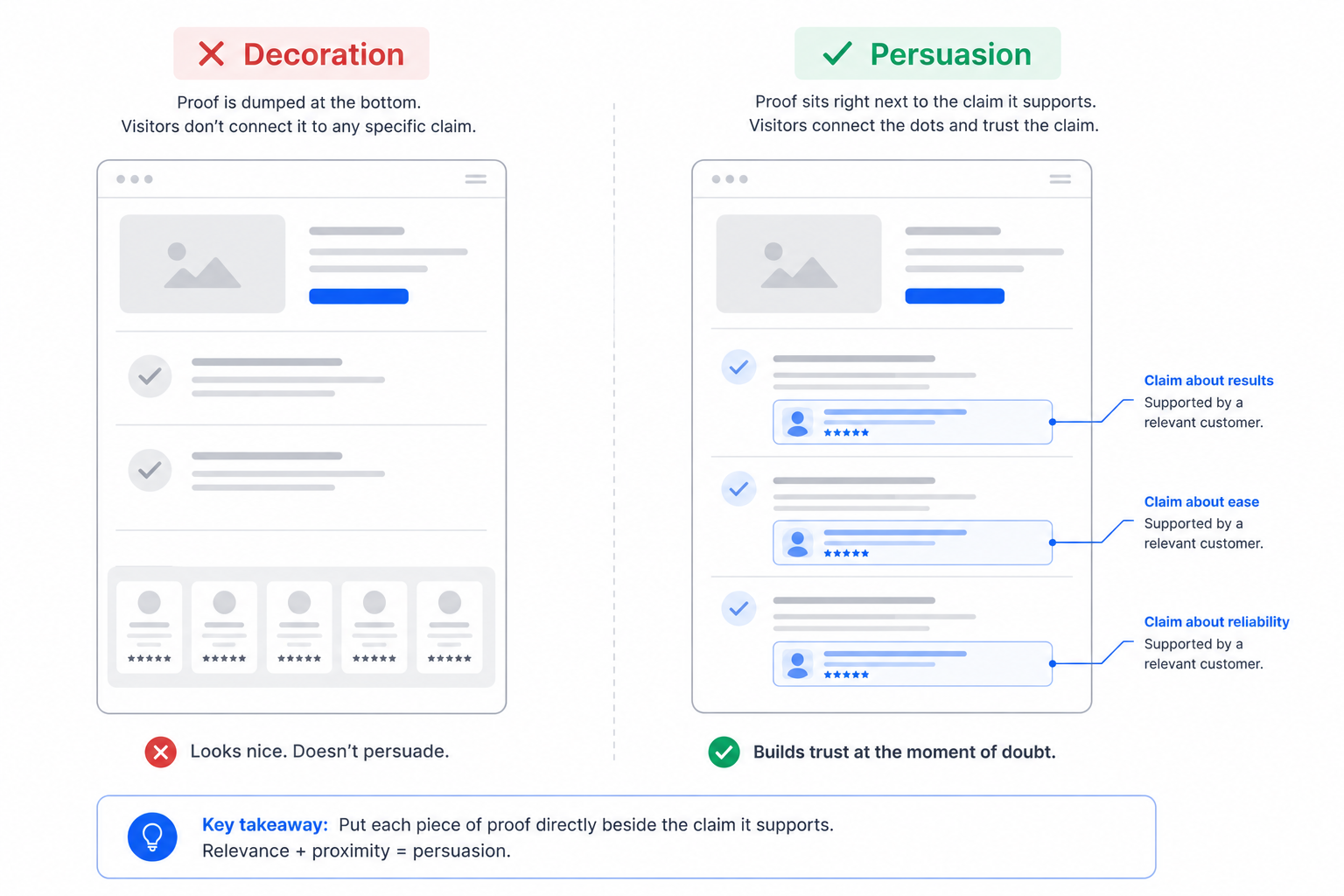
- Place proof next to claims. A review wall at the bottom is decoration. A specific testimonial directly beneath the claim it verifies is persuasion. Distribute proof through the page at the moments doubt naturally arises.
- Handle objections explicitly. Every product has two or three reasons people don't buy. Name them and answer them — in a comparison table, an FAQ, or a straight "you might be wondering" section. Unaddressed objections don't disappear; they bounce.
- Frame the offer with risk reversal. Guarantees, free returns, and "cancel anytime" terms work because the visitor's real fear is being wrong again. State the reversal plainly, near the CTA, in words a skeptic would write.
- Use directional cues, not decoration. Visual hierarchy should pull the eye down a single path: headline → proof → offer → CTA. Anything that doesn't serve that path — stock art, abstract icons, animation for its own sake — is friction wearing a costume.
- Give every traffic source its own page. TikTok cold traffic, Google branded search, and email retargeting arrive with different awareness levels and deserve different pages. One URL per campaign also keeps your test data clean.
How do I improve my landing page conversion rate?
Work the leaks in order of impact: fix message match first (headline vs ad), then above-the-fold clarity (can a visitor say what you sell and why in five seconds?), then mobile speed, then proof placement, then form or checkout friction. Diagnose with evidence — session recordings and funnel drop-off data — rather than opinion, and change one variable at a time so you know what worked. For the full testing methodology, see our landing page optimization guide; and if you're choosing tooling, note that most builders gate A/B testing above their entry tiers — our landing page builders comparison shows where testing actually unlocks on each platform.
What is a good landing page conversion rate?
Median landing page conversion rates sit around 2–4% for ecommerce purchase pages and 4–6% for lead generation. Well-optimised pages routinely reach 6–10% for ecommerce and 10–20% for lead gen, with quiz funnels higher still. Benchmarks vary by price point, traffic temperature, and category — which is why the more useful number is your own trend line: a page beating its own last version every quarter is healthy regardless of where it sits against the median.
Landing page best practices for paid traffic (Meta, Google, TikTok)
Paid traffic adds platform-specific rules. Meta: the page must pay off the creative's hook within the first viewport — visitors arrive mid-scroll with shallow intent, so the advertorial and listicle formats that rebuild context outperform straight product pages for cold audiences. Google Search: intent is explicit, so mirror the query in the headline and shorten the path to action; ad-to-page relevance also feeds your Quality Score and lowers CPC. TikTok: the youngest, coldest traffic — native-feeling editorial pages and quiz funnels consistently beat anything that looks like an ad. In all three cases the principle is the same: the page is a continuation of the click, not a fresh start.
The pre-launch landing page checklist
Before any page takes paid traffic, run it against these ten checks — each one maps to a practice above, and each is a leak we've found in real audits:
- ☐ The headline continues the exact promise of the ad sending traffic
- ☐ One primary CTA, visible in the first viewport, repeated after each proof section
- ☐ Navigation bar, footer link farm, and social icons removed
- ☐ Mobile LCP under 2.5 seconds on a real device, not just the simulator
- ☐ Every major claim has proof placed directly beside it
- ☐ The top three objections are named and answered on the page
- ☐ Risk reversal (guarantee, returns, cancel-anytime) stated near the CTA
- ☐ The form asks only for fields the sales process actually needs
- ☐ Analytics and conversion events fire correctly — verified, not assumed
- ☐ The 375px layout was reviewed and approved before the desktop version
Ten ticks and the unforced errors are gone; whatever leak remains is a research and testing problem, not a checklist problem.
Common landing page design mistakes to avoid
The failures we see most in audits: sending paid traffic to the homepage (it serves every audience, so it converts none); keeping the full site navigation on a campaign page; burying the offer below three scrolls of brand story; using stock photography where product proof should be; asking the form for fields the sales process doesn't need; "creative" headlines that prioritise cleverness over clarity; and launching without analytics events verified — meaning weeks of spend with no usable data. Each one is cheap to fix and expensive to ignore.
If you'd rather see than read: our landing page examples gallery shows these practices applied, with the results attached.